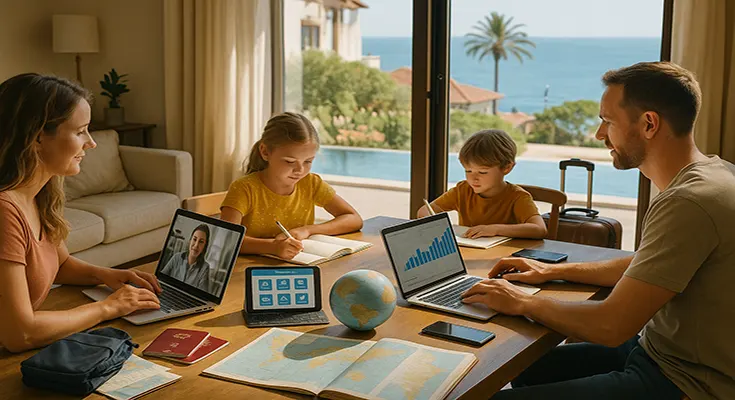
It is 8:55 AM on a Tuesday. I am currently sitting in a small Airbnb in Lisbon, desperately trying to angle my laptop so the pile of drying laundry behind me isn’t visible on my Zoom background. My 8-year-old is asking—loudly—where his swim goggles are, despite the fact that we are going to a museum, not the beach. My 12-year-old is complaining that the Wi-Fi is “laggy” and she can’t load her coding class.
I mute my microphone, take a deep breath, and smile at the camera.
Welcome to the glamour of full-time travel.
If you scroll through Instagram, you might think our life is a montage of sunsets, perfectly behaved children gazing at ruins, and parents typing effortlessly on laptops while sipping coconuts. And sure, those moments exist. But if you are looking for a worldschooling family travel blog for digital nomads that paints a picture of perfection, you might want to look elsewhere.
However, if you are looking for the truth about how we actually pull this off—how we balance full-time careers, educate our kids, and stay sane while living out of suitcases—then pull up a chair. It’s chaotic, it’s messy, and it is the best decision we ever made.
Vacation vs. Living: The Mental Shift
The first thing you have to understand is that we are not on vacation.
When you go on vacation for two weeks, you are in consumption mode. You eat out every meal, you rush to see every sight, and you blow your budget because “YOLO.”
When you are a digital nomad family, you are living. We still have to do taxes. We still have to go to the dentist (fun fact: dental care in Thailand is excellent). We still have to make dinner on a Tuesday night when everyone is tired. The only difference is that when we finish work and school, our “neighborhood walk” might be through a centuries-old medina in Morocco rather than a suburb in Ohio.
This shift is crucial. If you try to treat worldschooling like a perpetual vacation, you will burn out in three months. Guaranteed. We learned this the hard way. Now, we embrace the mundane. We have “boring days” where we don’t leave the apartment. These days are essential for our survival.
The Education Piece: The World Is the Classroom
The most common question we get on our worldschooling family travel blog for digital nomads is: “But what about school? Are you ruining their future?”
Worldschooling is not just “homeschooling on a plane.” It is the philosophy that the world itself provides a richer curriculum than any textbook.
When we were in Rome, we didn’t read a chapter about the gladiators. We stood in the center of the Colosseum and discussed the engineering required to flood the arena for naval battles. That is history and physics combined.
When we were in Vietnam, my son learned about inflation and currency conversion by buying fruit at the market. He had to figure out that 25,000 Dong was roughly one dollar. That is practical math.
However, let’s be practical. We still need structure. We are not “unschoolers” who let the kids do whatever they want all day. We use a hybrid model:
- Core Skills: We use apps like Khan Academy and Beast Academy for Math and English. These are non-negotiable. They do 45 minutes every morning.
- Online Classes: We rely heavily on Outschool. My daughter takes a creative writing class with a teacher in London and other kids from around the world. It provides social interaction and expert instruction that I can’t give her.
- Local Tutors: In Spanish-speaking countries, we hire local tutors for conversation practice. It supports the local economy and immerses the kids in the language faster than Duolingo ever could.
The Digital Nomad Reality: How We Actually Work
Let’s talk about the money. We are not trust fund babies. My partner and I both work 40-hour weeks remotely. How do we do it without getting fired?
1. The Holy Trinity of Nomad Needs Before we book any accommodation, we check three things. If one is missing, we don’t book.
- High-Speed Internet: I don’t trust the Airbnb listing that says “Wifi Available.” I ask the host for a screenshot of a speed test. We also travel with a global hotspot and local SIM cards as backups.
- Dedicated Workspace: Working from the kitchen table is fine for a week. It is torture for a month. We need a desk, or at least a separate room with a door that closes.
- Time Zone Overlap: We try to stay within roughly 4 hours of our employers’ time zones. Working 3 AM to 11 AM is possible for a while, but it ruins your health long-term.
2. The Art of Slow Travel In the beginning, we moved every week. It was a disaster. The kids were cranky, we were behind on work, and we saw nothing.
Now, our golden rule is one month minimum in each location. Staying for a month allows us to settle into a routine. We know where the grocery store is. The kids make friends at the local playground. We can work a full week and still have four weekends to explore the region. Slow travel is cheaper (monthly Airbnb discounts are huge) and it saves your sanity.
A “Real Life” Tuesday Schedule
To show you what this actually looks like, here is a breakdown of a typical Tuesday in our life right now:
- 7:00 AM: Parents wake up. Coffee. I tackle my “deep work” (writing, strategy) before the emails start flooding in.
- 8:30 AM: Kids wake up. Breakfast.
- 9:00 AM – 11:30 AM: The Power Block. One parent works while the other supervises “Table Time” (Math, English, Online Classes). If both parents have meetings, the iPad is our babysitter, and we don’t feel guilty about it.
- 12:00 PM: Lunch. We try to eat out at a local spot (cheap street food usually) to get fresh air.
- 1:00 PM – 5:00 PM: Shift Change. The parent who supervised school in the morning goes into deep work mode. The other parent takes the kids out. This is the “Worldschooling” part—visiting a museum, a park, or just navigating the subway system.
- 6:00 PM: Dinner and family time.
- 8:00 PM: Kids in bed. Parents might log back on for an hour to clear the inbox or plan the weekend trip.
Finding Your Tribe (And Avoiding Loneliness)
I cannot write a worldschooling family travel blog for digital nomads without mentioning the loneliness. It is real. Kids need peers, and frankly, so do parents.
We intentionally route our travels through “Worldschooling Hubs.” Places like Bansko (Bulgaria), Playa del Carmen (Mexico), and Ubud (Bali) are packed with families like ours.
There are Facebook groups for almost every major city (search “Worldschooling [City Name]”). In these hubs, we find co-ops, park meetups, and parents who want to grab a glass of wine and complain about visa runs. These communities are our lifeline. They turn a solitary journey into a shared adventure.
Is It Worth It?
There are days when the flight is delayed, the kids are crying, the internet is down, and I miss my comfortable couch and Amazon Prime delivery. On those days, I wonder why we left the suburbs.
But then, I watch my daughter order dinner in confident Spanish. I see my son quietly sketching a cathedral. I realize that we have eaten dinner together as a family every single night for two years.
We are not just building a resume or a travel map; we are building a childhood defined by curiosity rather than confinement.
If you are on the fence, I want you to know: You will never be fully “ready.” The logistics will never be perfect. But if you have the remote job and the will to try, the world is waiting to teach you.