
Budgeting Strategies for Mid-Career Micro-Retirements and Sabbatical Travel

Budgeting Strategies for Mid-Career Micro-Retirements and Sabbatical Travel

In the traditional arc of a professional career, “retirement” is a finish line reached in the mid-60s. However, 2026 has seen a paradigm shift toward the micro-retirement: a deliberate, mid-career hiatus lasting anywhere from three months to two years. Unlike a vacation, which is a temporary escape, a sabbatical is a strategic “reset” designed to prevent burnout, facilitate skill acquisition, or simply reclaim time during one’s peak physical years.

The primary hurdle to this lifestyle is not the desire, but the math. Successfully executing a micro-retirement requires moving beyond basic savings into sophisticated financial architecture. You must fund your life today while ensuring your “future self” remains on track for traditional retirement.

Phase 1: The “Runway” Calculation

Your “Sabbatical Nut” is the total liquidity required to walk away from your paycheck without anxiety.

  1. The Baseline: Calculate your current monthly burn rate.
  2. The Sabbatical Multiplier: Multiply that by your intended

Budgeting Strategies for Mid-Career Micro-Retirements and Sabbatical Travel Read More
Maximizing Your 2026 Travel Budget: The September Shoulder Season Strategy

Maximizing Your 2026 Travel Budget: The September Shoulder Season Strategy

In the world of travel, timing is not just a preference; it is a financial lever. As we navigate the economic and climatic shifts of 2026, the traditional “summer vacation” has become a gauntlet of “heat domes,” overcrowded landmarks, and hyper-inflated pricing. For the savvy traveler, the solution lies in the September Shoulder Season Strategy.

By shifting your departure date by just 14 to 21 days—moving from late August to mid-September—you can effectively double the purchasing power of your travel budget while enjoying superior environmental conditions. This is the “Golden Window” where luxury becomes accessible, and the “Slow Travel” philosophy yields its highest dividends.

1. The “Post-August Pivot”: 2026 Economics

The economics of September travel are driven by the “Post-August Pivot.” In both the US and Europe, the first week of September marks a hard transition in consumer demand. As the academic year resumes and corporate “Q4 planning” begins, …

Maximizing Your 2026 Travel Budget: The September Shoulder Season Strategy Read More
How to Align Travel Budget Planning with Corporate Carbon Allowance Goals

How to Align Travel Budget Planning with Corporate Carbon Allowance Goals

For decades, corporate travel management was governed by a single metric: the bottom line. Success was defined by negotiated airline discounts and hotel room rates. However, as we move through 2026, a new constraint has entered the boardroom. Driven by the “Fit for 55” legislation in Europe and similar SEC-adjacent reporting mandates in the US, the CFO and the Chief Sustainability Officer (CSO) are now co-authoring travel policies.

The result is Dual-Constraint Planning. In this framework, every business trip must fit within two distinct “wallets”: the financial budget and the carbon allowance. To succeed, organizations must move beyond the era of passive carbon offsetting and into the era of active carbon intelligence.

1. The “Green Budget” Framework

The shift to a carbon-aligned budget requires treating $CO_2e$ (carbon dioxide equivalent) as a secondary currency. If a department has a $100,000 travel budget but has already exhausted its 50-tonne carbon allowance, …

How to Align Travel Budget Planning with Corporate Carbon Allowance Goals Read More

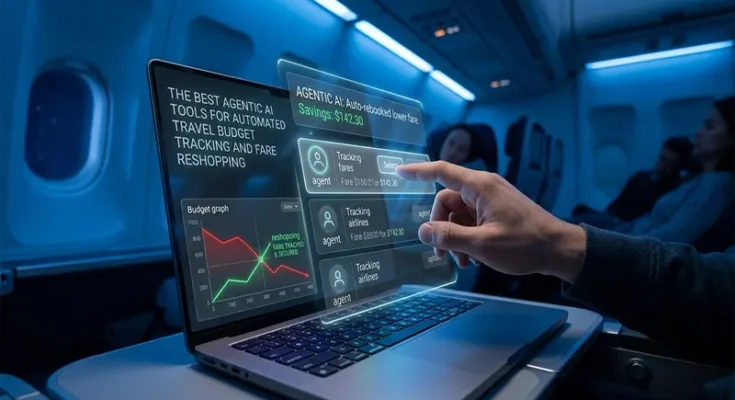
The Best Agentic AI Tools for Automated Travel Budget Tracking and Fare Reshopping

For years, the travel industry has flirted with artificial intelligence in the form of chatbots that could retrieve flight times or offer generic recommendations. In 2026, however, we have crossed the Rubicon. We are no longer living in the era of “Generative AI”—which simply answers questions—but the era of “Agentic AI,” which acts on behalf of the traveler to execute complex, multi-step workflows.

In the corporate and luxury travel landscape, the true value of AI is not found in a chatbot’s ability to summarize a hotel review. It is found in its ability to negotiate a fare, audit a receipt, and autonomously rebook a trip the moment a price drops, all while maintaining strict adherence to corporate policy. This is the new baseline for frictionless travel.

Defining the Agentic Shift: From Planning to Executing

To understand why this is a revolution, one must distinguish between the two modes of AI. …

The Best Agentic AI Tools for Automated Travel Budget Tracking and Fare Reshopping Read More
Navigating Destinations with a Personalized Travel Budget Calculator

Navigating Destinations with a Personalized Travel Budget Calculator

Traveling is a great way to experience new cultures, try new foods, and make unforgettable memories. However, planning a trip can be overwhelming, especially when it comes to budgeting. With the rise of technology, it has become easier to track expenses and ensure that you stay within your budget. One tool that can be incredibly helpful in achieving this is a personalized travel budget calculator.

A travel budget calculator is a tool that helps you determine how much money you need for a trip. It takes into account different expenses, such as flights, accommodation, food, transportation, activities, and travel insurance. By inputting your expenses and desired trip length, you can get a rough estimate of your total expenses.

However, not all travel budget calculators are created equal. While some may be generic, others can be personalized to your specific needs. Personalized travel budget calculators take into account your preferences, such …

Navigating Destinations with a Personalized Travel Budget Calculator Read More