
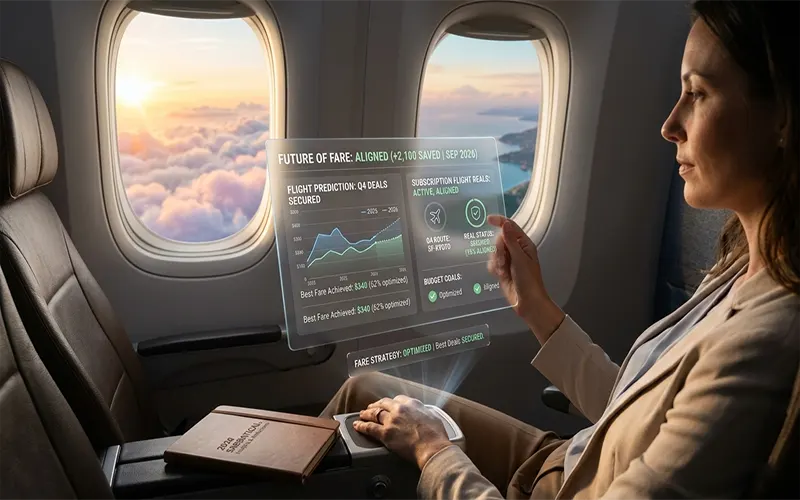
The era of manual flight searching is officially over. For years, savvy travelers spent hours toggling between tabs, clearing browser cookies, and tracking prices on spreadsheets. In 2026, the landscape has shifted from aggregation (showing you what is available) to automation (predicting and securing what will be available).
The emergence of Agentic AI—artificial intelligence capable of reasoning, planning, and executing tasks autonomously—has turned travel planning into a hands-off experience. Today’s top tools don’t just find deals; they act as digital concierges that understand market volatility better than any human agent.
1. Fare Prediction Titans: The Logic of “When to Buy”
Predictive AI has reached a level of accuracy in 2026 that was previously impossible, thanks to the integration of large-scale historical flight data and real-time macroeconomic modeling.
Hopper: The Risk-Mitigation Specialist
Hopper has evolved beyond a simple “Watch” button. Its 2026 algorithm utilizes deep learning to offer “Price Freeze” and “Refund for Any Reason” features that are essentially AI-backed insurance policies.
- The Tech: Hopper’s AI analyzes trillions of flight prices daily to predict price movements with 95% accuracy.
- The 2026 Edge: If the AI predicts a price drop but you need to book now, Hopper allows you to “Freeze” the current price for a small fee. If the price goes up, Hopper pays the difference; if it goes down, you pay the lower price.
Google Flights AI Insight
Google has moved its “Price Guarantee” out of beta and into a core feature of the search experience.
- The Tech: By leveraging historical LLM (Large Language Model) data, Google can now predict the exact day a price will bottom out for specific seasonal routes.
- The 2026 Edge: Google now provides a “Confidence Score” for every fare. If the score is high and you book, Google automatically monitors the price and initiates a refund via Google Pay if the fare drops before departure.
2. The Subscription Revolution: Curated Excellence
In 2026, “deal fatigue” is a real problem. Travelers no longer want every deal; they want the right deal. Subscription services have pivoted to hyper-personalized AI filtering.
Going (formerly Scott’s Cheap Flights)
Going has mastered the “Human + AI” hybrid model. While AI scans for “Mistake Fares” (like a $200 Business Class seat to Tokyo), human editors ensure the routing is actually travel-worthy.
- The 2026 Elite Tier: This tier uses AI to cross-reference your “Preferred Airports” and “Frequent Flyer Status.” It only alerts you to deals that maximize your specific loyalty points or depart from your home hub, eliminating the noise of irrelevant alerts.
Skyscanner’s ‘Smart Subscription’
Skyscanner has introduced “Shadow Booking,” a feature that uses AI to simulate thousands of potential bookings in the background.
- The Tech: The AI identifies “Shadow Inventory”—seats that airlines are likely to discount but haven’t officially listed on the GDS (Global Distribution System) yet.
- The 2026 Edge: Subscribers receive a “Pre-Alert” hours before a major sale goes live, allowing them to be first in line for limited-inventory “Saver” seats.
3. AI-Driven ‘Hack’ Strategies
The most sophisticated 2026 tools go beyond the front page of the internet to exploit “hidden” pricing structures.
The ‘Re-Shop’ Protocol
The most valuable AI tool in your 2026 kit isn’t one that finds a flight, but one that stays on the job after you’ve paid. Tools like Earny and Capital One Shopping have evolved into “Re-Shop” agents. Once you link your travel confirmation, the AI monitors the fare 24/7. If the price drops, the agent can autonomously cancel and re-book the flight (assuming it’s within the free-cancellation window) or alert you to claim a voucher.
Skiplagging 2.0
While “hidden city” ticketing remains controversial, 2026 AI tools have made it safer. Advanced algorithms now flag flights where “Skiplagging” is possible but also analyze airline-specific data to warn you about the risk of losing frequent flyer miles or being “blacklisted,” allowing for an informed risk-benefit analysis.
4. The ROI of Paid Subscriptions
Is it worth paying $49 to $199 a year for a flight-deal subscription? In 2026, the answer is usually found in the Subscription Break-Even Point (BEP).
To calculate if a subscription is worth it, use this simple formula:
$$BEP = \frac{\text{Subscription Cost}}{\text{Avg. Savings per Trip}}$$
Example: If a subscription costs $99/year and the AI saves you an average of $350 per trip, your break-even point is 0.28. This means you only need to book one trip every three years to justify the cost. For most 2026 travelers, a single “Mistake Fare” booking pays for the subscription for a decade.
5. 2026 Tool Comparison
| Feature | Hopper | Google Flights | Going (Elite) | Skyscanner |
| Best For | Risk Management | Real-time Search | High-Value Curation | Global Reach |
| Prediction Level | High (Financial) | High (Statistical) | Medium (Trend) | High (Inventory) |
| Automation | Price Freeze | Auto-Refunds | Personalized Alerts | Shadow Booking |
| Ideal User | Nervous Planner | Data Enthusiast | Luxury Seekers | Budget Nomads |
6. Privacy and the “On-Device” Shift
A major trend in 2026 is the shift toward Privacy-First AI. Modern travel assistants now perform most of their data processing “on-device.” This means your frequent flyer numbers, budget constraints, and family details stay on your phone or laptop rather than being uploaded to a central cloud server. This allows the AI to provide hyper-personalization—knowing you prefer window seats on the right side of the plane for the view—without compromising your digital security.
The “Future of Fare” is defined by Automation over Aggregation. In 2026, the most successful travelers aren’t the ones who search the hardest; they are the ones who deploy the best agents. By leveraging the predictive power of Hopper, the curated precision of Going, and the autonomous “Re-Shop” protocols of modern AI, you can ensure that you are always paying the absolute minimum for every mile flown.