Japan is currently the world’s most desirable travel destination. It is the bucket-list trip of the decade—a place where the past and future collide in a way that feels almost hallucinatory.
But for the sophisticated traveler, Japan presents a unique paradox: it is incredibly safe, yet incredibly inaccessible.
While anyone can book a flight to Tokyo, accessing the “real” Japan—the one you see in documentaries, with the silent bamboo forests, the private tea ceremonies, and the hidden sushi counters—is nearly impossible for an outsider. The barrier isn’t just language; it is trust. Japan operates on shinyo (trust) and shokai (introduction).
If you are planning a trip of a lifetime, you cannot rely on a guidebook written three years ago. You need a certified travel advisor for custom Japan itineraries. Here is why the “DIY” approach in Japan is a recipe for a generic, stressful vacation, and how a certified specialist unlocks the doors that remain bolted to the public.
The “Google Trap”: Why DIY Fails in Japan
In most Western countries, if you have a credit card and an internet connection, you can book the best experiences. In Japan, this is simply not true.
The “Google Trap” is the false belief that all information is available online. In Japan, the best experiences—the ones you actually want—often have no digital footprint. Many of Kyoto’s finest ryokans (traditional inns) and Tokyo’s top omakase counters do not list their inventory on Expedia or Booking.com. They do not have English websites. They do not take reservations from unknown international numbers.
Furthermore, the logistical landscape of Japan has shifted dramatically in the last 18 months.
- The Rail Pass Complexity: The Japan Rail (JR) Pass, once a no-brainer for tourists, saw a massive price increase recently. For many luxury itineraries, it is no longer the smart choice. A certified advisor runs the fare calculations to determine if individual first-class (Green Car) tickets or private transfers are actually more efficient.
- The “No-Go” Zones: In response to over-tourism, districts like Gion in Kyoto have instituted bans on tourists in specific private alleys. A blog post from 2022 won’t tell you this, but a certified advisor knows exactly which streets are restricted and how to navigate the city respectfully without getting fined.
- The Dining blockade: Many high-end restaurants operate on an ichigensan okotowari basis—”no first-time customers.” You cannot just walk in, and you cannot book online. You need an introduction from a trusted local partner.
What Does “Certified” Actually Mean?
When we talk about a certified travel advisor for custom Japan itineraries, we aren’t talking about someone who just likes anime and sushi.
True certification, such as the Japan Travel Specialist designation recognized by the Japan National Tourism Organization (JNTO), requires rigorous study and verified experience. But beyond the badge, “certified” in the luxury space means vetted connectivity.
A certified advisor works directly with Destination Management Companies (DMCs) on the ground in Japan. These are local teams that act as the advisor’s eyes and ears. They are the ones who personally know the general manager at the Park Hyatt; they are the ones who have the personal cell phone number of the guide who has a key to the private temple gardens.
This certification is your insurance policy against mediocrity. It ensures your advisor understands the nuanced difference between a “commercial” ryokan (which is essentially a hotel with tatami mats and a buffet) and an “authentic” ryokan (a centuries-old, family-run estate where dinner is served in your room by a kimono-clad attendant dedicated solely to you).
The Art of the Custom Itinerary: moving Beyond Tokyo-Kyoto
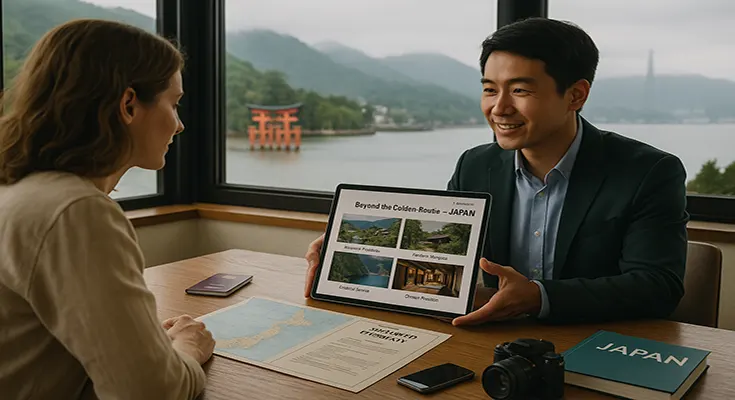
The standard “Golden Route” (Tokyo, Kyoto, Osaka) is where 90% of tourists go. It is crowded, loud, and often feels like a theme park. A certified travel advisor for custom Japan itineraries listens to why you want to go to Japan, and then designs a route that dodges the crowds while hitting the emotional notes you are seeking.
1. Listening to the “Why”
We start by diagnosing your travel style.
- The Urbanist: You want the energy of Shinjuku at night, high-end fashion in Ginza, and architecture tours in Omotesando.
- The Traditionalist: You want to walk the Nakasendo trail, sleep in wooden villages, and soak in sulfur-rich hot springs in the mountains of Hakone or Kyushu.
- The Art Lover: You want the “Art Islands” of Naoshima and Teshima, staying in the Benesse House museum.
2. Accessing the Inaccessible
This is where the advisor earns their fee. Once we know your style, we use our network to unlock experiences that are simply not bookable by the public.
- Private Geisha Entertainment: Most tourists only see a “Geisha show” in a crowded theater or, worse, harass them on the street for a photo. A certified advisor can arrange an Ozashiki—a private dinner in a tea house where a Geiko and Maiko entertain your family exclusively. This is a rare window into a dying art form, facilitated only through deep local connections.
- Sumo Morning Practice: Getting tickets to a Sumo tournament is difficult; getting inside the Heya (stable) to watch the morning practice is nearly impossible for tourists. We can arrange a visit where you sit in silence, feet from the wrestlers, watching the sweat and discipline of their morning training—a visceral, powerful experience far removed from the stadium crowds.
- The “Introduction-Only” Sushi Experience: Do you want to eat at the famous 8-seat counters in Ginza? We don’t just call; we leverage our DMC partners to vouch for you, securing a seat that would otherwise be “fully booked” for the next year.
3. Logistical Choreography
Japan is a country of rules and schedules. Miss a train, and your luggage service might fail. A certified advisor choreographs the movement.
- We arrange Luggage Forwarding (Takkyubin), so your heavy bags skip the train and meet you at your next hotel. You travel with just a handbag, feeling light and unencumbered.
- We book Private Guides, not just for navigation, but for cultural translation. They bridge the gap, explaining why you bow, how to pray at the shrine, and what you are eating, adding depth to the visuals.
Conclusion: Turning Confusion into Clarity
Japan is not a “wing it” destination. It rewards preparation and respect. The complexity of its rail system, the etiquette of its dining, and the opacity of its booking systems are designed to filter out the unprepared.
By hiring a certified travel advisor for custom Japan itineraries, you are not just buying a plane ticket. You are buying an advocate, a translator, and a key-holder. You are ensuring that when you finally stand in front of that vermilion torii gate or taste that piece of fatty tuna, you are fully present—not worrying about how to get back to the hotel.
Japan waits for no one, but for the right guest, it opens its doors wide. Let us ensure you are the guest they are expecting.
Ready to experience the real Japan?
The best ryokans and guides book up 9 to 12 months in advance. If you are considering a trip for the upcoming Sakura (Cherry Blossom) or Momiji (Fall Foliage) seasons, the time to start planning is now.