The Zero-Waste Carry-On: How to Pack a Sustainable Long-Haul Flight Kit

The Zero-Waste Carry-On: How to Pack a Sustainable Long-Haul Flight Kit

In 2026, the aviation industry remains one of the most challenging sectors to decarbonize, but the waste generated within the cabin is a problem we can tackle individually. On a single long-haul flight, the average passenger generates roughly 1.43kg of waste. Multiplied by a 300-person aircraft on a 12-hour journey, that equals nearly half a tonne of trash—composed mostly of single-use plastic cups, poly-wrapped blankets, and non-recyclable meal trays.

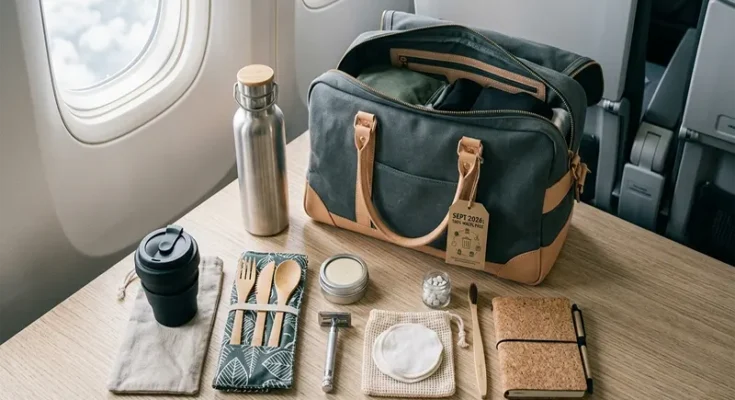
Creating a zero-waste carry-on kit isn’t just about being “eco-friendly”; it’s about reclaiming your comfort and autonomy. By opting out of the airline’s disposable loop, you ensure that your travel footprint doesn’t linger for centuries in a landfill. Here is the tactical blueprint for a plastic-free journey.

1. The Hydration Strategy: Beyond the Plastic Cup

The most frequent “trash event” on a flight is the beverage service. Every tiny plastic cup used for a sip of water adds up.

  • The Vessel:
The Zero-Waste Carry-On: How to Pack a Sustainable Long-Haul Flight Kit Read More
Advanced Biohacking: Molecular and Biological Hacks to Eliminate Jet Lag

Advanced Biohacking: Molecular and Biological Hacks to Eliminate Jet Lag

In the high-performance world of 2026, the concept of “jet lag” is no longer viewed as an inevitable side effect of travel, but as a temporary state of circadian dysregulation that can be systematically corrected. To the elite traveler, a long-haul flight is a series of environmental “insults”—cosmic radiation, recycled air, and artificial light—that desynchronize the body’s internal timing.

Eliminating jet lag requires more than just sleeping on the plane; it requires a targeted intervention into the molecular mechanisms that govern our biological clocks.

1. The Biological Mechanism: The SCN and Peripheral Clocks

The human body is not governed by one single clock, but by a hierarchy of timekeepers. At the apex is the Suprachiasmatic Nucleus (SCN), located in the hypothalamus. The SCN is the “Master Clock,” primarily entrained by light entering the retinas.

However, every major organ—the liver, gut, and kidneys—possesses its own peripheral clock. Jet lag …

Advanced Biohacking: Molecular and Biological Hacks to Eliminate Jet Lag Read More
The Truth About Worldschooling: How We Balance 9-to-5 Jobs with Global Education

The Truth About Worldschooling: How We Balance 9-to-5 Jobs with Global Education

It is 8:55 AM on a Tuesday. I am currently sitting in a small Airbnb in Lisbon, desperately trying to angle my laptop so the pile of drying laundry behind me isn’t visible on my Zoom background. My 8-year-old is asking—loudly—where his swim goggles are, despite the fact that we are going to a museum, not the beach. My 12-year-old is complaining that the Wi-Fi is “laggy” and she can’t load her coding class.

I mute my microphone, take a deep breath, and smile at the camera.

Welcome to the glamour of full-time travel.

If you scroll through Instagram, you might think our life is a montage of sunsets, perfectly behaved children gazing at ruins, and parents typing effortlessly on laptops while sipping coconuts. And sure, those moments exist. But if you are looking for a worldschooling family travel blog for digital nomads that paints a picture of perfection, you …

The Truth About Worldschooling: How We Balance 9-to-5 Jobs with Global Education Read More
The Ultimate Long-Haul Survival Guide: In-Cabin Pet Travel Tips

The Ultimate Long-Haul Survival Guide: In-Cabin Pet Travel Tips

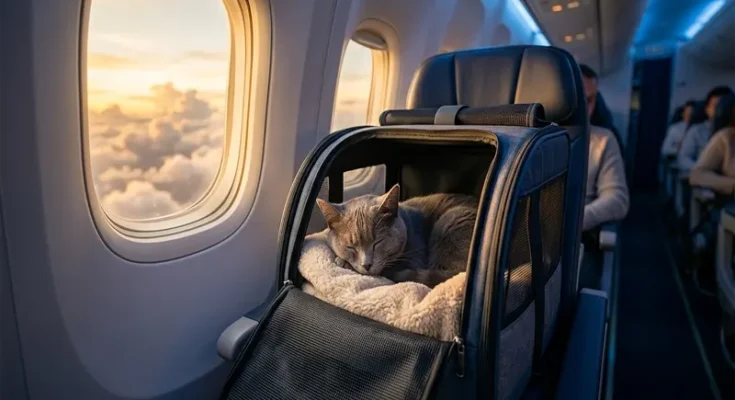
Crossing oceans with a pet in the cabin is a feat of logistical engineering and emotional endurance. Unlike a short domestic hop, a long-haul flight (typically defined as eight hours or more) pushes the physiological and psychological limits of your animal. To successfully navigate a 12-hour journey from New York to Tokyo or London to Dubai, you must transition from being a “pet owner” to a “flight coordinator.”

This guide provides a veterinary-backed blueprint for ensuring your dog or cat doesn’t just survive the journey, but remains regulated throughout the high-altitude experience.

The Biological Toll: Altitude, Pressure, and the Pet Nervous System

Before packing a single treat, it is vital to understand what happens to a pet’s body at 35,000 feet. The aircraft cabin is pressurized, but the air is significantly thinner and drier than at sea level.

  • Hydration and Respiration: Low humidity in the cabin causes rapid moisture loss
The Ultimate Long-Haul Survival Guide: In-Cabin Pet Travel Tips Read More
The Invisible Woman? Think Again. Why My 50s Are My Golden Age of Travel

The Invisible Woman? Think Again. Why My 50s Are My Golden Age of Travel

Society tells women a very specific story about aging. It tells us that once the children are grown, the career is peaked, and the hair turns silver, we are supposed to fade quietly into the background. We are supposed to become “invisible.”

To that, I say: Good.

Because while the world wasn’t looking, I was booking a one-way ticket to Lisbon.

If you had told me at 25 that my most adventurous years would begin at 55, I would have laughed. Back then, travel was a chaotic mix of heavy backpacks, cheap hostels, and anxiety. Now? It is silk scarves, direct flights, and the kind of deep, resonant confidence that only comes from living five decades on this earth.

I started this journey because I realized I had spent thirty years being a “we.” I was a wife, a mother, a daughter, an employee. I was the Chief Caretaker of …

The Invisible Woman? Think Again. Why My 50s Are My Golden Age of Travel Read More