
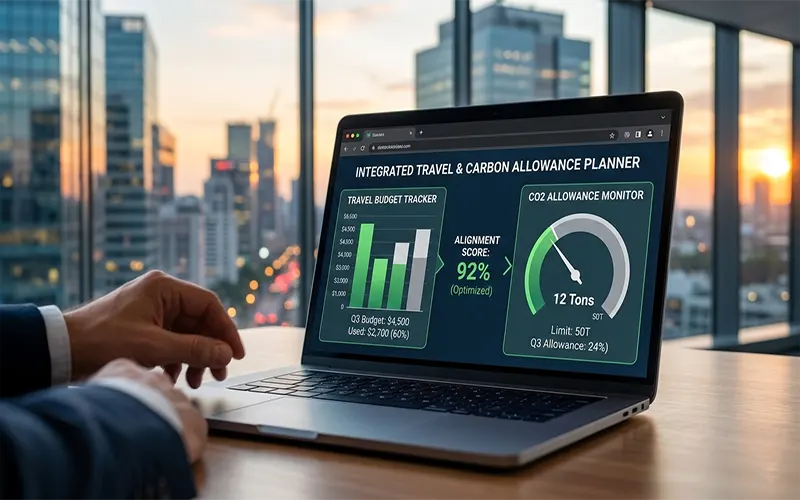
For decades, corporate travel management was governed by a single metric: the bottom line. Success was defined by negotiated airline discounts and hotel room rates. However, as we move through 2026, a new constraint has entered the boardroom. Driven by the “Fit for 55” legislation in Europe and similar SEC-adjacent reporting mandates in the US, the CFO and the Chief Sustainability Officer (CSO) are now co-authoring travel policies.
The result is Dual-Constraint Planning. In this framework, every business trip must fit within two distinct “wallets”: the financial budget and the carbon allowance. To succeed, organizations must move beyond the era of passive carbon offsetting and into the era of active carbon intelligence.
1. The “Green Budget” Framework
The shift to a carbon-aligned budget requires treating $CO_2e$ (carbon dioxide equivalent) as a secondary currency. If a department has a $100,000 travel budget but has already exhausted its 50-tonne carbon allowance, the financial surplus is effectively frozen.
This necessitates a Carbon Shadow Price. By assigning a theoretical cost—typically between $80 and $150 per tonne of $CO_2e$—to every trip, companies can bake the “environmental tax” into their internal cost-benefit analysis.
The Calculation:
To determine the climate impact of a specific leg, travel managers use the standard emission factor formula:
$$E = d \times EF \times AF$$
Where:
- $E$ is the total emissions ($kg CO_2e$).
- $d$ is the distance traveled ($km$).
- $EF$ is the emission factor (varying by transport mode).
- $AF$ is the “Adjustment Factor” for radiative forcing at high altitudes.
2. Integrating Carbon Intelligence into Booking
The most effective way to align these goals is to intercept the decision at the point of sale. In 2026, Agentic AI has been integrated into Travel Management Companies (TMCs) to act as a “sustainability co-pilot.”
- Emission-First Sorting: Instead of “Lowest Price,” booking tools now default to “Lowest Carbon” for any trip under 500km.
- Contextual Nudging: If an employee attempts to book a flight between Paris and Lyon, the AI agent proactively blocks the search and presents a rail option, noting the 90% reduction in emissions and the negligible difference in door-to-door travel time.
- Real-time Allowance Tracking: As the traveler selects a flight, a sidebar displays their remaining annual carbon allowance, forcing a conscious trade-off: “Is this face-to-face meeting worth 15% of my yearly carbon limit?”
3. The “Modal Shift” Strategy: Rail vs. Air
The most significant reduction in Scope 3 emissions comes from the “Modal Shift”—moving travelers from planes to high-speed rail. However, the corporate hurdle has always been the perceived loss of productivity.
To align budgets, companies are now calculating the Productivity ROI of Rail. While a flight from London to Amsterdam may take 1 hour (excluding 3 hours of airport logistics), a 4-hour train journey offers “Deep Work” time with consistent Wi-Fi and no “electronics-off” periods.
The Hierarchy of Sustainable Travel:
- Avoid: Can this be a virtual meeting?
- Shift: Can this flight be a train or electric vehicle journey?
- Reduce: Can we combine three trips into one multi-city itinerary?
- Improve: If flying is a must, is there a Sustainable Aviation Fuel (SAF) option?
- Inset: Invest in high-quality carbon removal within the aviation value chain.
4. Beyond Offsets: SAF and Carbon Insetting
In 2026, “Carbon Offsetting” (buying forest credits to apologize for a flight) is increasingly viewed as “greenwashing” by regulators. The industry has moved toward Carbon Insetting, specifically through Sustainable Aviation Fuel (SAF).
Corporations are now allocating a portion of their travel budget to “Pre-purchase” SAF credits. By paying a premium on their corporate fares, they directly fund the decarbonization of the airline’s fuel supply. This allows the company to claim a direct reduction in their Scope 3.6 emissions (Business Travel) rather than just balancing the books with external credits.
5. Gamification and Individual Allowances
To drive cultural change, the most successful firms are “democratizing” the carbon budget. Every employee is issued a Personal Carbon Allowance (PCA).
- Carbon Cash-Back: Some firms have introduced “Green Rebates.” If an employee finishes the fiscal year with 20% of their carbon allowance remaining, a portion of the financial savings is returned to them as a bonus or donated to a climate charity of their choice.
- Leaderboards: Departmental dashboards show which teams are the most “carbon-efficient,” turning sustainability into a point of pride rather than a restriction.
6. Data & Reporting: The Single Source of Truth
Alignment is impossible without visibility. Organizations must integrate their TMC data with ESG reporting platforms (like Persefoni or Watershed). This ensures that the finance team isn’t looking at “Estimated Spend” while the sustainability team looks at “Actual Emissions.”
A unified dashboard allows for Predictive Modeling. If the company plans a 10% expansion in the Asia-Pacific market, the dashboard can immediately forecast the carbon “cost” of that expansion and suggest “Virtual-First” onboarding to keep the company within its science-based targets.
The New Executive Mandate
Aligning travel budgets with carbon goals is no longer an “extra” for the annual report; it is a fundamental requirement for operational resilience. By utilizing Agentic AI for booking, enforcing modal shifts, and investing in SAF insetting, corporations can continue to grow their global footprint without expanding their environmental one. The companies that master this “Dual-Constraint” reality will be the ones that navigate the regulatory and social landscape of the late 2020s with ease.