
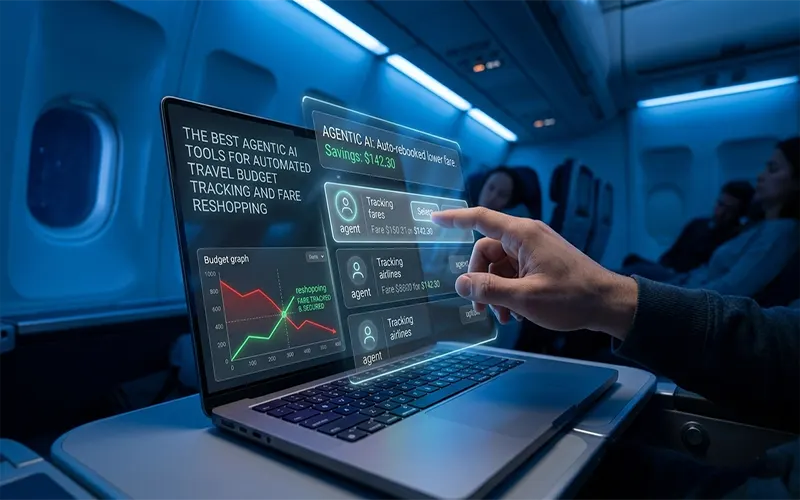
For years, the travel industry has flirted with artificial intelligence in the form of chatbots that could retrieve flight times or offer generic recommendations. In 2026, however, we have crossed the Rubicon. We are no longer living in the era of “Generative AI”—which simply answers questions—but the era of “Agentic AI,” which acts on behalf of the traveler to execute complex, multi-step workflows.
In the corporate and luxury travel landscape, the true value of AI is not found in a chatbot’s ability to summarize a hotel review. It is found in its ability to negotiate a fare, audit a receipt, and autonomously rebook a trip the moment a price drops, all while maintaining strict adherence to corporate policy. This is the new baseline for frictionless travel.
Defining the Agentic Shift: From Planning to Executing
To understand why this is a revolution, one must distinguish between the two modes of AI. Generative AI acts as a consultant; it provides data, insight, and itinerary options. Agentic AI, by contrast, acts as a proxy.
In a modern 2026 travel stack, an AI agent possesses “agency”—the authority to utilize tools (via APIs) to make changes. This includes interacting with airline systems, hotel reservation platforms, and financial ledgers. We are now seeing the rise of A2A (Agent-to-Agent) communication, where a user’s personal assistant agent negotiates directly with a supplier’s agent. When your agent detects a lower fare, it doesn’t just notify you; it contacts the airline’s inventory system, validates the refund policy, and executes the rebooking.
Automated Budget Tracking & Expense Management
The biggest drain on a travel manager’s time has always been the reconciliation of expenses. In 2026, that manual work is effectively obsolete.
Navan: The Expense Agent Standard
Navan has emerged as a leader here, moving far beyond basic automation. Its Expense Agent is a powerhouse of structured data extraction. By connecting directly to booking sources, the agent captures over 130 data points per transaction. It doesn’t just “read” a receipt; it links that receipt to the specific flight, the traveler’s corporate profile, and the policy guardrails set by the company.
Because it operates in real-time, the agent can stop out-of-policy spend before a credit card is even swiped. It essentially turns the company’s travel policy into a “live firewall,” preventing financial leakage rather than simply reporting it after the books are closed.
SAP Concur: Predictive Governance
SAP Concur has moved aggressively into agentic orchestration with its Joule assistant. Its new Pre-spend Planner is a game-changer for budget volatility. By analyzing historical travel patterns and real-time market data, the planner forecasts budget requirements for upcoming trips. If a trip is projected to exceed the department’s budget, the agent proactively offers alternatives—perhaps moving a business-class flight to premium economy or suggesting a hotel with better negotiated rates—before the booking is confirmed.
Autonomous Fare Reshopping and Price Protection
Perhaps the most tangible ROI for the modern traveler is the automated capture of “missed savings.”
Skyscanner & Hopper: Beyond Alerts
Platforms like Hopper and Skyscanner have evolved their “Savvy Search” capabilities. In previous years, these tools alerted you to price drops. Today, they operate as autonomous rebookers. If you have granted these agents “execution permission,” they will watch your booked itinerary 24/7.
When a fare drops below a specified threshold—factoring in any change fees or airline-specific conditions—the agent autonomously initiates the rebooking process. This is the definition of “set it and forget it” yield management for the individual traveler.
Oversee.biz and the “Missed Savings” Capture
For enterprises, platforms like Oversee.biz represent the pinnacle of post-booking optimization. These agents run continuously in the background, treating every booked flight not as a finished transaction, but as a dynamic asset. If a flight drops in price three days after booking, the agent captures the credit, updates the expense log, and reconciles the account balance automatically.
The Custom “Agent Team” Approach: Decomposition
The most advanced travelers and companies are now utilizing Agent Factory methodologies, which rely on “Decomposition.” Rather than having one “super-agent” try to do everything, you deploy a team of specialized micro-agents:
- The Monitoring Agent: Tracks price fluctuations and disruption alerts.
- The Policy Agent: Validates every action against corporate mandates.
- The Reconciliation Agent: Updates the ledger and synchronizes with accounting software (NetSuite, Sage).
By orchestrating these agents in parallel, you create an “autonomous enterprise” where travel planning and budget tracking are handled in the background, requiring human intervention only when a decision requires nuance, such as high-stakes policy exceptions or complex client negotiations.
Comparison of Key Agentic Tools (2026)
| Tool | Primary Agentic Strength | Ideal For |
| Navan | Policy enforcement & auto-reconciliation | Enterprise Finance Teams |
| SAP Concur (Joule) | Pre-spend forecasting & policy alignment | Large Corporations |
| Hopper | Autonomous price drop rebooking | Leisure & Individual Business |
| Skyscanner | Multi-source fare discovery & execution | Price-Sensitive Travelers |
| Oversee.biz | Continuous post-booking optimization | High-Volume Corporate Travel |
Governance, Privacy, and the “Kill Switch”
With autonomy comes the need for rigorous governance. In 2026, the primary concern for travel tech is not whether the AI can do it, but whether we trust it to do it.
Leading tools now include a “Human-in-the-loop” kill switch. Whether it’s a manual toggle in an app or an automated rule—such as “Never rebook a flight if the total connection time exceeds 4 hours”—users maintain ultimate control. Secure API handshakes ensure that an agent cannot access a credit card without authentication, and data privacy protocols ensure that your travel history is not used to train third-party models without explicit permission.
The Future is Frictionless
The transition to agentic travel is the final step in removing the “admin tax” from the journey. By leveraging these tools, travelers and companies aren’t just saving money—they are reclaiming the hours once spent on receipt-chasing, fare-tracking, and policy-firefighting. In 2026, the best travel tool is one you rarely have to touch; it is the one that simply works in the background, ensuring your budget is optimized and your itinerary is as efficient as possible.