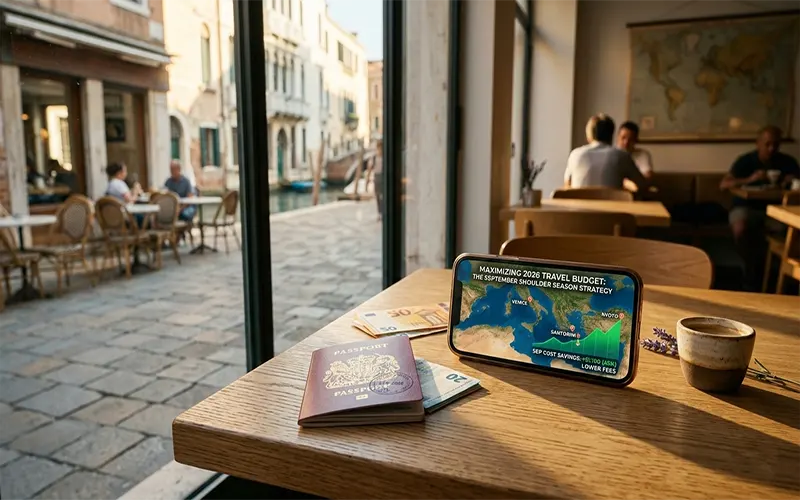
In the world of travel, timing is not just a preference; it is a financial lever. As we navigate the economic and climatic shifts of 2026, the traditional “summer vacation” has become a gauntlet of “heat domes,” overcrowded landmarks, and hyper-inflated pricing. For the savvy traveler, the solution lies in the September Shoulder Season Strategy.
By shifting your departure date by just 14 to 21 days—moving from late August to mid-September—you can effectively double the purchasing power of your travel budget while enjoying superior environmental conditions. This is the “Golden Window” where luxury becomes accessible, and the “Slow Travel” philosophy yields its highest dividends.
1. The “Post-August Pivot”: 2026 Economics
The economics of September travel are driven by the “Post-August Pivot.” In both the US and Europe, the first week of September marks a hard transition in consumer demand. As the academic year resumes and corporate “Q4 planning” begins, leisure demand craters.
- The 40% Discount: In 2026, data suggests that 4- and 5-star accommodations in primary markets see a price drop of 30% to 50% starting the Tuesday after Labor Day.
- The Business Travel Lag: While corporate travel picks up in September, it is concentrated in “hub cities” (London, Frankfurt, New York). This leaves “leisure-primary” destinations—like the Amalfi Coast or the Greek Isles—with high-end inventory they are desperate to fill.
- The Flight Arbitrage: Airlines often classify September as “Low Demand” for award redemptions. You can frequently find Business Class “Saver” seats for the same points-price as an August Economy seat.
2. Targeting High-Value Destinations in 2026
To maximize the strategy, you must target regions where the gap between “Peak” and “Shoulder” is the widest.
Southern Europe: The Mediterranean Reset
In July, places like Santorini or Mallorca are not just expensive—they are physically taxing due to 40°C temperatures. By September, the “Heat Domes” have typically dissipated, but the Mediterranean Sea remains at its warmest annual temperature. You are essentially getting “Peak Summer” weather with “Off-Peak” pricing.
Southeast Asia: The Monsoon Gamble
September is the tail-end of the rainy season for parts of Thailand, Vietnam, and Cambodia. In 2026, “Agentic AI” weather modeling allows travelers to identify “micro-climates” (like Koh Samui) that remain dry while the rest of the region sees rain. Booking luxury villas in these zones can result in 60% savings compared to the December peak.
3. The “Second Summer” Weather Advantage
Climate shifts in 2026 have fundamentally extended the “swimmable” season. What was once a risky bet in late September is now a statistical certainty in many parts of the Northern Hemisphere.
| Destination | July Avg Temp | Sept Avg Temp | July Avg Price (Per Night) | Sept Avg Price (Per Night) |
| Amalfi Coast, Italy | 31°C (Humid) | 26°C (Perfect) | $850 | $420 |
| Bali, Indonesia | 27°C (Crowded) | 27°C (Quiet) | $500 | $310 |
| Algarve, Portugal | 33°C (Extreme) | 25°C (Mild) | $400 | $190 |
4. Tactical Booking Hacks for September
The 21-Day Booking Rule
Unlike summer travel, which requires 6-month lead times, September travel in 2026 benefits from a “21-Day Window.” Airlines often release “Distress Inventory” three weeks out to fill seats that business travelers haven’t claimed. Setting an AI-driven price monitor for this specific window can save an additional 15% on airfare.
The “Slow Travel” Multiplier
September is the ideal month for 7- to 14-day stays. Because hotels have lower occupancy, they are 4x more likely to accept “Long-Stay” discount requests (often 20% off) than they are in July.
5. Leveraging Agentic AI for “Last-Minute Luxury”
In 2026, autonomous agents can monitor “Inventory Flux.” Many travelers book September trips as a “backup” to their summer plans, leading to a high volume of cancellations in late August when credit card statements for summer trips arrive.
An AI agent can be programmed to:
- Monitor specific 5-star properties for “Standard Room” cancellations.
- Execute a booking the moment a “Deal” threshold is met.
- Negotiate via automated chat for a “Shoulder Season Upgrade” based on your loyalty status.
6. The 2026 September “Hot-List”
If you are looking for the absolute best value-to-cost ratio this September, focus on these three undervalued regions:
- The Peloponnese, Greece: Often overlooked for the islands, this region offers incredible stone villas and ancient sites at a fraction of the Mykonos price point.
- The Azores, Portugal: September is the best time for whale watching and hiking before the Atlantic winter gales begin.
- Hoi An, Vietnam: The “Inter-Monsoon” period offers lush green landscapes and luxury beach resorts for under $150 USD per night.
The September Shoulder Season Strategy is not about “traveling cheap”; it is about traveling smart. It is the realization that the most expensive month to travel is often the least pleasant. By aligning your 2026 travel budget with the natural lull of the post-summer market, you can afford the suite instead of the room, the direct flight instead of the layover, and the private tour instead of the crowd.