
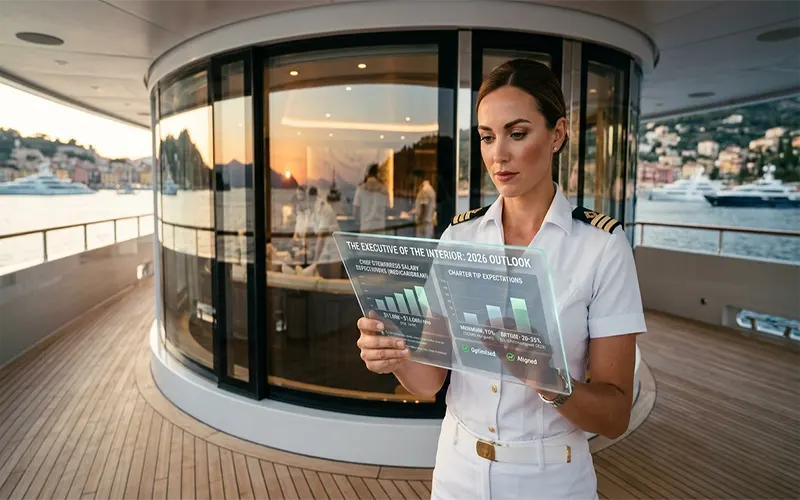
In the rarefied world of superyachting, the role of the Chief Stewardess (Chief Stew) has undergone a fundamental transformation. As we move through 2026, the position has evolved from high-end housekeeping into a complex role better described as Interior Manager. On modern “giga-yachts,” a Chief Stew is an executive-level administrator overseeing multimillion-dollar inventories, managing diverse international teams, and executing events that rival five-star land-based resorts—all while maintaining a 24/7 “invisible service” standard.
The compensation for this level of pressure is significant, consisting of a base salary, substantial charter tips, and a benefits package designed to mitigate the intense physical and mental toll of the industry.
1. 2026 Salary Benchmarks by Vessel Size
In yachting, the size of the vessel is the primary driver of the pay scale. As the volume of the “interior” increases, so does the administrative burden.
| Vessel Size | Role Profile | Monthly Salary (USD/EUR) |
| 30m – 50m | Hands-on Lead: Often a team of 2–3. The Chief Stew is still “on the floor,” serving drinks and detailing cabins alongside management tasks. | $6,500 – $8,500 |
| 50m – 80m | Departmental Head: Managing 4–8 stews. Focus shifts to provisioning, event planning, and training. Direct guest interaction is high-level. | $8,500 – $11,000 |
| 100m+ (Giga) | Interior Manager: Managing 10–25+ stews. This is a “white gloves off” role involving high-level logistics, recruitment, and accounting. | $12,000 – $18,000+ |
Note: Salaries are typically paid 12 months a year, even during “yard periods” or when the boat is guest-free.
2. The Charter Tip Economy
For crew on charter yachts, the base salary is often just the baseline. Tips (gratuities) are the “variable” that can double or triple an annual income. The Mediterranean and Caribbean standards in 2026 remain a baseline of 10% to 20% of the base charter fee.
The Tip Calculation
Tips are almost always pooled and divided equally among the crew, regardless of rank, to ensure the “unseen” crew (Engineers, Chefs, Deckhands) are incentivized to provide a seamless experience.
To calculate an individual’s share ($S$) from a total tip pool ($T$) for a crew of ($n$) members:
$$S = \frac{T}{n}$$
Example: A 60m yacht charters for $500,000 per week. A happy guest leaves a 15% tip ($75,000). If there are 15 crew members, each receives a share of $5,000 for one week of work. In a busy 2026 summer season with 10 weeks of charter, a Chief Stew could realistically take home $50,000 in tips alone.
3. Private vs. Charter: The Financial Trade-Off
Choosing between a private-use-only yacht and a heavy-charter yacht is the most critical career decision for a Chief Stew.
- Private Yachts: These offer higher base salaries and more stability. The owners may use the boat only 4–6 weeks a year, allowing the crew to focus on deep maintenance and a better work-life balance. However, there are no tips.
- Charter Yachts: Base salaries may be slightly lower, but the earning potential is uncapped. The “burnout” rate is higher due to back-to-back guest trips with only 24-hour “turnarounds” in between.
4. The 2026 Benefits Package: Rotation is King
In 2026, the industry has realized that high turnover is more expensive than good benefits. “Rotation” is now the gold standard for experienced Chief Stews.
- Rotation (2:2 or 3:1): The “2 months on, 2 months off” (2:2) or “3 months on, 1 month off” (3:1) model allows the Chief Stew to maintain a personal life while receiving full pay during their time off.
- Training Bonds: Many yachts now offer to pay for advanced sommelier, floristry, or management courses (e.g., the GUEST Program) in exchange for a one-year commitment to the vessel.
- Health & Wellness: 2026 contracts frequently include premium global health insurance, dental, and even mental health support/counseling subscriptions.
5. Career Longevity and The Exit Strategy
The physical demands of being a Chief Stew—standing for 16 hours, navigating stairs in high seas, and constant “on-stage” performance—usually limit the career to 5–10 years. In 2026, we are seeing a professionalization of the “Exit Strategy.”
- Shore-based Management: Chief Stews are transitioning into Yacht Management (overseeing the operations of multiple vessels from an office) or Estate Management (running high-end private residences for ultra-high-net-worth individuals).
- Consultancy: Many veteran stews are launching “Interior Training” businesses, teaching the next generation the nuances of “7-star” service.
Total Annual Earnings Potential (2026 Estimate)
| Scenario | Base Salary (Annual) | Estimated Tips | Total Gross Income |
| Private 45m (No Rotation) | $90,000 | $0 | $90,000 |
| Charter 60m (With Tips) | $108,000 | $45,000 | $153,000 |
| Giga-Yacht Manager (Rotation) | $160,000 | $20,000* | $180,000 |
| *Giga-yachts often have fewer, but much larger, charter tips. |
The role of a Chief Stewardess in 2026 is a high-stakes, high-reward career that requires a unique blend of emotional intelligence, logistical mastery, and physical stamina. While the “entry-level” is grueling, those who reach the Chief rank on large vessels are among the highest-paid hospitality professionals in the world. As the fleet grows and owners demand increasingly bespoke experiences, the financial and professional value of a top-tier Chief Stew will only continue to rise.