From June 11 to July 19, 2026, North America will host the largest sporting event in history. With 48 teams competing across 16 host cities in the U.S., Mexico, and Canada, the travel industry is bracing for a demand surge of unprecedented proportions. In cities like Los Angeles, Monterrey, and Toronto, hotel rates are projected to hit $300\%$ premiums, and flight availability will be virtually non-existent.
However, for the luxury traveler who prefers tranquility over the roar of a stadium, this massive migration creates a rare market phenomenon: The World Cup Vacuum. While the world’s attention and disposable income are laser-focused on a few specific GPS coordinates, traditional luxury “safe zones” will experience a significant drop in demand. By employing the World Cup Swap, you can secure elite experiences at a fraction of their typical mid-summer cost.
1. The Inverse Demand Theory: The “Vacuum” Effect
Economic arbitrage in travel relies on the “Inverse Demand Theory.” In 2026, the World Cup will act as a giant magnet, pulling millions of high-net-worth travelers away from their usual summer haunts.
When millions of North Americans stay home to host or attend matches, they aren’t booking their usual June trips to the French Riviera or the Colorado Rockies. This creates a surplus of inventory in luxury markets that are historically “sold out” a year in advance. Furthermore, many non-sports fans avoid travel altogether during mega-events to sidestep perceived chaos, further depressing prices in non-host regions.
2. Identifying the 2026 “Safe Zones”
To execute the swap, you must identify “demand shadows”—areas that are geographically close to the action but strategically ignored by the tournament crowd.
The Non-Host Hubs
While 16 cities are hosting, many major North American metropolises are not. In June 2026, cities like Chicago, Washington D.C., Denver, and Montreal will likely see a dip in luxury hotel occupancy. These cities possess world-class dining and cultural institutions but will be “on sale” as travelers prioritize the matches in cities like Seattle or Philadelphia.
The European “Quiet Window”
July is typically the most expensive month to visit the Mediterranean. However, in 2026, the European fanbase—the largest segment of luxury travelers to the Med—will be heavily diverted toward the U.S. and Mexico.
- The Swap: Look for 5-star villas in Tuscany, the Algarve, or the Swiss Alps. While the weather will be peak-summer perfect, the lack of North American and European “event-goers” will likely lead to “Early Bird” luxury promotions and higher-tier room availability.
3. The Flight Inversion Strategy
Airlines are profit-maximizing machines. They will flood host cities with “Inbound” capacity, often at exorbitant prices. The arbitrage opportunity lies in the Reverse Route.
- Outbound Arbitrage: While a flight from London to New York on July 4, 2026, will be astronomical, the “Empty Leg” phenomenon occurs for flights leaving the U.S. toward Europe or South America during the group stages.
- The Logic: Airlines need to get their planes back to their hubs to pick up the next wave of fans. If you are flying away from the World Cup hubs while the tournament is in full swing, you can often find “Saver” level award seats in Business Class that are usually blocked during the summer peak.
4. Timing the “Knockout” Openings
The World Cup is an elimination tournament, and travel demand follows the bracket. This is where “Last-Minute Luxury” becomes a reality.
As major nations are eliminated (the “Knockout Rounds” starting June 27), their heartbroken fanbases often cancel secondary travel plans or return home early.
- The Tactical Move: If a major European power (e.g., Germany or France) exits early, luxury resorts in those home countries—which might have been quiet due to the “stay-at-home-and-watch” effect—often release last-minute inventory to stimulate local “staycation” demand.
5. 2026 Cost Comparison: Match-Day vs. Swap-Day
| Category | Host City (e.g., Miami) | Swap City (e.g., Chicago) | Percentage Difference |
| 5-Star Hotel (Nightly) | $1,200+ | $450 | -62.5% |
| Business Class Fare | $3,500 (Peak) | $1,800 (Inversion) | -48% |
| Michelin Dining Res. | Impossible | Available | N/A |
| Private Tour Access | Waitlist Only | Wide Open | N/A |
6. The 2026 Tech Edge: Finding the Shadows
In 2026, you don’t have to guess where the shadows are. Use Agentic AI tools to monitor Demand Volatility.
- Set a “Shadow Alert”: Instruct your AI agent to monitor the 5-year average price for a specific luxury resort.
- The Trigger: “Alert me if the rate for the Amalfi Coast in July 2026 drops 15% below the 2025 rate.”
- The Execution: The AI can recognize the “World Cup Dip” in real-time and secure the booking before the general public realizes the value.
The 2026 Swap Hot-List
- Aspen, Colorado: With the world’s elite focused on stadium suites, this mountain luxury mecca will offer a peaceful, high-value alternative to the humid, crowded host cities.
- The Caribbean (Low Season Plus): Already a value destination in June, the Caribbean will be significantly overlooked by North American travelers in 2026, leading to “Ultra-Luxury” deals.
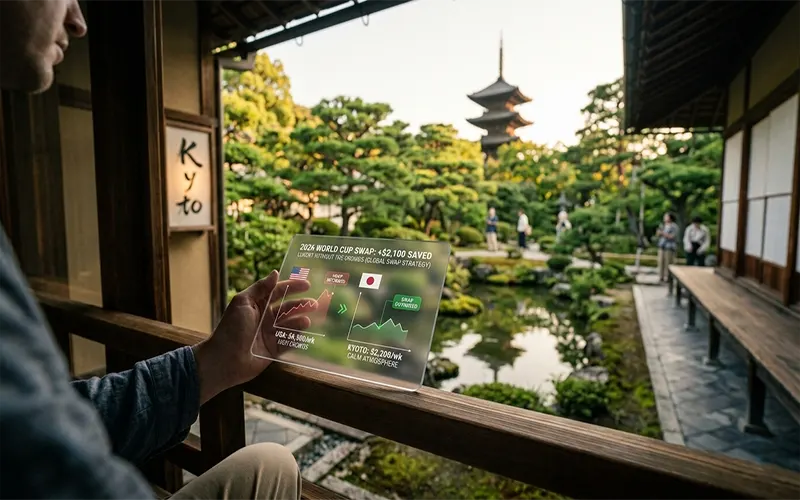
- Tokyo, Japan: For the ultimate swap, leave the Western Hemisphere entirely. With the Americas and Europe fixated on the Atlantic, trans-Pacific luxury travel may see a “calm window” perfect for high-end exploration.
The World Cup is a spectacle of human achievement, but for the traveler, it is also a massive disruption of market equilibrium. By understanding the “World Cup Swap,” you can turn this disruption into an advantage. In 2026, the most luxurious thing you can buy isn’t a ticket to the final; it’s the peace, space, and value found in the cities the rest of the world has momentarily forgotten.